OpsGrid · Working capital · Business Central

141 days in approval is working capital sitting idle.

Business Central shows the purchase order. It doesn't show that nine of them sat in approval for 141 days — cash your business already committed, waiting on one person to click approve.

Decision Infrastructure

Not a report. A system with an output.

OpsGrid routes operational signals to named owners in Teams, captures their approval, and executes the action in Business Central — with a full audit trail. Every step governed.

BC data crosses a threshold — stuck approvals, unacknowledged POs, recurring unresolved alerts. OpsGrid detects it.
The signal goes to a predefined owner — not a group inbox. One person. One responsibility. SLA clock starts.
Owner acts in Teams. One click — approve, reject, or escalate. No new app. No BC login required.
Approved action writes to Business Central. Nothing executes without explicit human approval — architectural constraint, not a policy.
Who decided. When. What they chose. Every BC write logged. The audit trail that makes your operation defensible.
Act from Microsoft Teams Predefined ownership — no ambiguity $0 unauthorized BC writes Full audit trail, automatic
The working capital cost of decision latency

A $50M operation carries $800K–$2.4M per year in decision latency cost — cash committed to purchase orders and approvals that sit unresolved, working capital your balance sheet already counts as spent but your operation hasn't deployed. Business Central had the data. Nobody routed the decision.

Where working capital gets stuck

The governance gap that shows up on your balance sheet.

These are the failure patterns that turn committed cash into idle cash. Each one exists because Business Central records the commitment but doesn't route the decision that releases it.

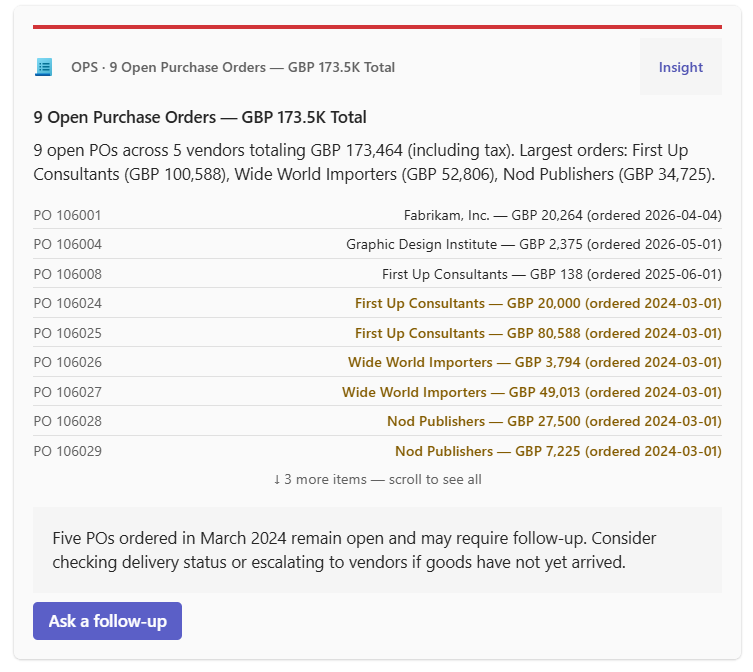
  • Purchase orders stuck past SLA, cash already committed 9 POs sitting in approval for 141 days — capital your team allocated but hasn't deployed
  • No dashboard line for capital waiting on a decision DSO and DPO get reported every close. The cash sitting in an unactioned approval queue doesn't have a line item
  • One approver holding 40% of outstanding decisions Concentration risk on the person who releases working capital — not a staffing problem, a routing one
  • Audit exposure on undocumented approvals No record of who approved what, when, or why — a gap that surfaces in the wrong quarter, during the wrong review
  • Override history missing from financial controls Every time a decision owner overrode policy, unlogged — the record that makes your controls defensible
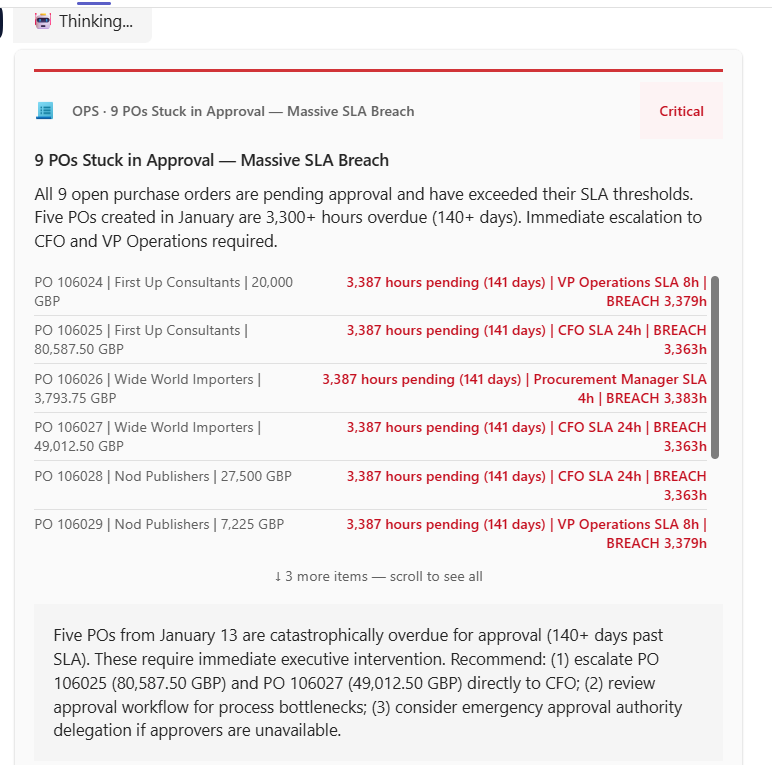
OpsGrid governance signal — live from Business Central
9 POs Stuck in Approval — 141 day SLA breach Open Purchase Orders by Vendor

OpsGrid Beta · Dynamics 365 Business Central · sample data

How OpsGrid releases the capital

Signal. Named owner. Approval. Execution. Audit trail.
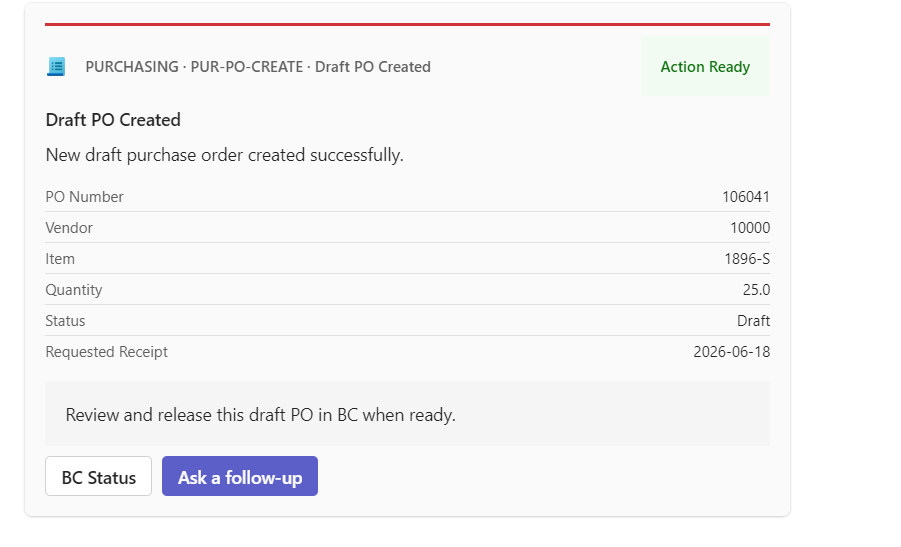
OpsGrid monitors BC for operational signals that require a decision. Every signal is ranked by capital at risk and assigned to a named decision owner with a response SLA — no ambiguity about who releases the cash.
The signal surfaces in Microsoft Teams as an actionable card — context, cost, and recommended action included. One-click approve, reject, or escalate. No new dashboard. No new login.
Approved action executes directly in BC. Nothing writes to Business Central without explicit human approval — an architectural constraint, not a policy. Every decision, every override, every outcome logged to a full audit trail your controls can stand behind.
OpsGrid decision workflow — live from Business Central
9 POs Stuck in Approval Draft PO Created — approved action in BC

OpsGrid Beta · Dynamics 365 Business Central · sample data

Finance view

The decision funnel, signal health, and full audit trail — in the language your controls need.

Every decision that ran through OpsGrid — who owned it, when it was acted on, what happened. A defensible record for the CFO and the auditor, not an export or a pivot table.
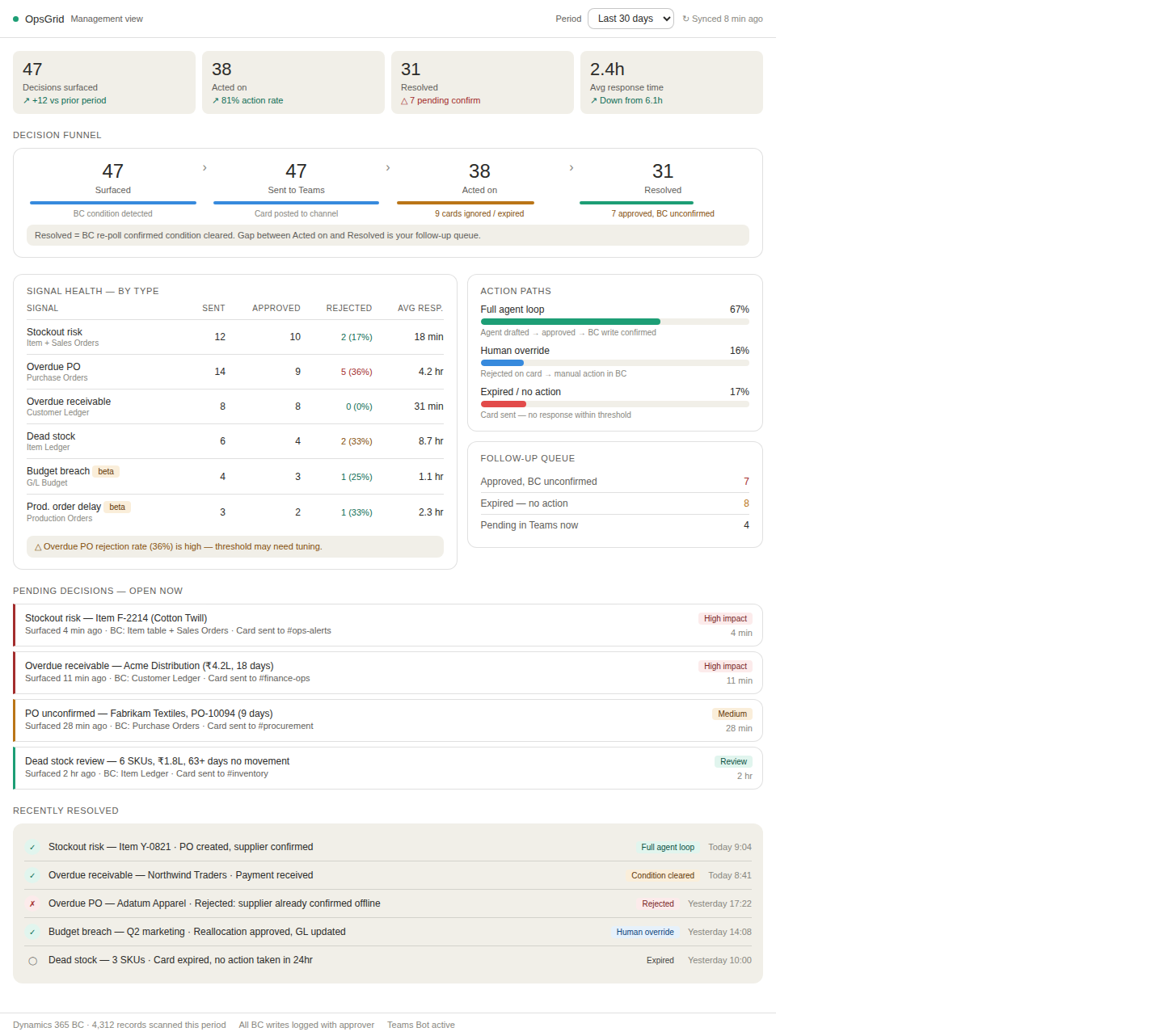
OpsGrid Management Dashboard showing decision funnel (surfaced to acted to resolved), signal health by type with response times, and full audit trail of every approved and overridden decision
Decision funnel
Surfaced → Teams → Acted → Resolved. Drop-off at each stage shows where capital is stalling — not a people problem, a routing one.
Signal health by type
Cards sent, approved, rejected, avg response time — per signal type. High expiry rate means capital isn't reaching the person who can release it.
Full audit trail
Every decision logged — who decided, when, what they chose. Every BC write recorded with approver. The record that holds up in a controls review.

Actual OpsGrid Beta screenshot · Dynamics 365 Business Central · sample data

What's next
30-minute call
Book a Working Capital Audit

30 minutes. We identify the cash currently sitting in stuck approvals and estimate what it's costing you in working capital, not just operations. No slides. A number and a map.

Book the call →
LinkedIn
Connect with Christopher Wakare

Christopher leads IQ's deployment work. If you'd rather start with a message, connect on LinkedIn and send a note about what you're running into.

Connect on LinkedIn ↗
60×
faster decisions — 2.3 days to 1.2 hours
$0
unauthorized BC writes — baked into the architecture
2 wks
from BC connection to live decision routing

From one active OpsGrid beta deployment · Dynamics 365 Business Central · mid-market manufacturer · baseline at project start, outcomes at 30 and 90 days.

Decision Latency Diagnostic

See where your working capital stalls — in 3 minutes.

Not the cost calculator on the OpsGrid page — this is the stage-by-stage breakdown of where in Signal → Route → Approve → Execute → Audit your decisions, and your cash, stall. 12 questions, scored, mapped to your weakest stage.

Take the Decision Latency Diagnostic →

12 questions · 3 minutes · Free · Full stage breakdown unlocks with your email