OpsGrid · Supplier delay alerts · Business Central

The vendor’s already late. You find out when the line needs the part.

The promised date that passed and the vendor late four times this quarter: both sit in Business Central before the line feels them, once a buyer has keyed the date in. Nobody’s watching for it early enough to act.

The cost of finding out a supplier is late from the line, not the PO

Supplier deliveries to US manufacturers were “slower in October for the 11th consecutive month,” and production-material lead times averaged 87 days (ISM October 2026 Manufacturing PMI Report). A late part found at the line turns into a rush shipment. Across 5,211 companies, expedited costs run at a median 12.0% of freight cost (APQC Open Standards Benchmarking, measure 108919).

What OpsGrid surfaces

Two supplier signals. Surfaced before the damage is done.

Supplier performance data your purchasing team currently assembles manually, or discovers too late. OpsGrid pulls it from BC on a schedule (every 6 hours planned).

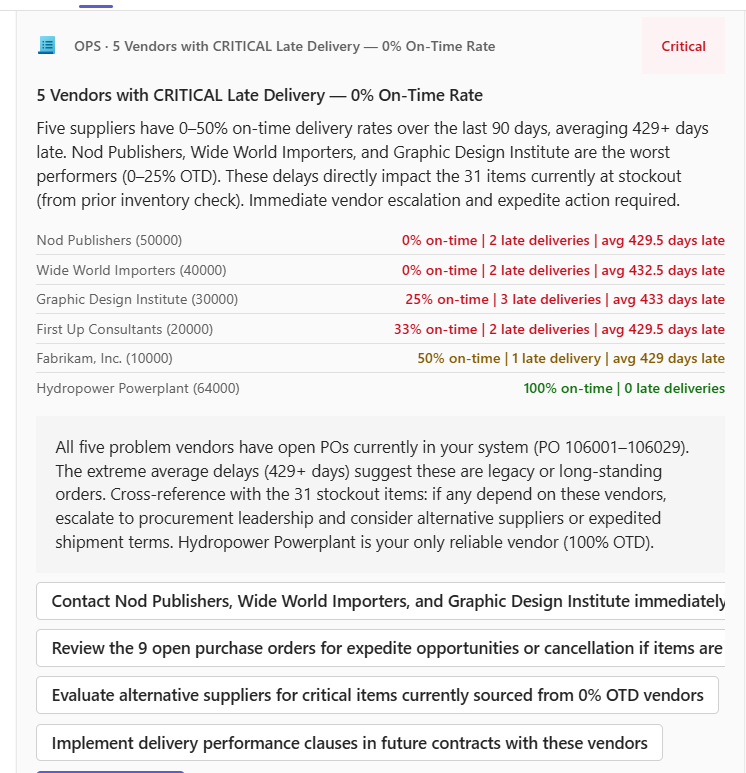
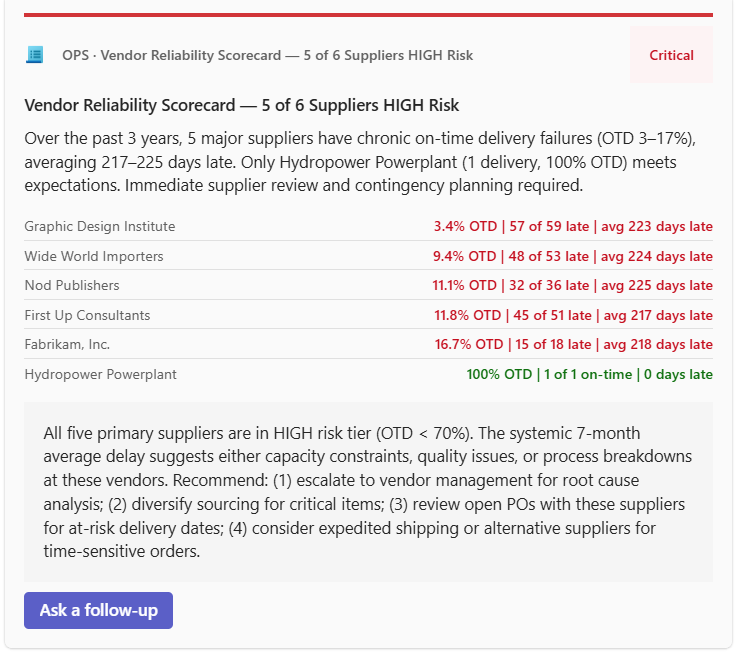
  • Supplier on-time delivery: worst performers ranked by revenue at risk Not an average. Each vendor’s OTD trend with the specific open orders exposed
  • Overdue deliveries: past promised date Every line past its promised date, ranked by production dependency and days overdue
Decision owner: Procurement Lead · BC write: none. An alert to the named owner, who acts.

See all 28 decisions OpsGrid surfaces 17 live today, 11 on the roadmap, ranked by what the delay costs you
5 Vendors Critical Late Delivery
5 Vendors Critical Late Delivery Vendor Reliability Scorecard

OpsGrid Beta · Dynamics 365 Business Central · sample data

How it works

Supplier risk surfaces in Teams, with a name on it.

OpsGrid checks your Business Central purchasing data on a schedule (every 6 hours planned). Every open PO, delivery date and vendor’s on-time history, compared with the thresholds you set.
When a supplier misses a threshold, a ranked card fires in Microsoft Teams to the named Procurement Lead. Revenue at risk shown. Days overdue shown.
The Procurement Lead chases the vendor, moves the date or expedites. OpsGrid writes nothing to BC for this signal.
Decision Infrastructure

BC already logs the missed date. Nobody owns acting on it.

OpsGrid routes supplier signals to a named owner in Teams. The owner acts; OpsGrid writes nothing to Business Central for this signal.

Once a buyer enters the promised date, BC knows the moment it passes. The gap is that it reaches a shared inbox, or nobody, instead of one named Procurement Lead who can act on it.
Act from Microsoft Teams Predefined ownership, no ambiguity 0 BC writes without a named approver Full audit trail, automatic
2 to 3 wks
from BC connection to live signals
What's next
30-minute call
Book a Decision Latency Audit

30 minutes. We identify the 3–5 operational decisions currently slowing your business and estimate what each delay costs. No slides. A number and a map.

Book the call →
LinkedIn
Connect with Christopher Wakare

Christopher leads IQ's deployment work. If you'd rather start with a message, connect on LinkedIn and send a note about what you're running into.

Connect on LinkedIn ↗