Business Central flagged it Monday. Someone made a decision Friday.
The signal was there. The data was current. The decision took four days anyway: nothing in BC routes operational signals to named owners, captures approvals, and executes the action without a meeting, an email thread, or a weekly ops call.
Not a report. A system with an output.
OpsGrid routes operational signals to named owners in Teams, captures their approval, and executes the action in Business Central, with a full audit trail. Every step governed.
A $50M operation loses $800K–$2.4M per year to decision latency: missed OTIF, emergency freight, dead inventory, and the manual coordination labor of people chasing down approvals that should have happened Monday. Decisions that BC already had the data for. Nobody routed them.
The governance gap OpsGrid closes.
These are the failure patterns OpsGrid is built to eliminate. Each one exists because Business Central records facts but doesn't route them to decision owners.
- Operational signals with no named owner BC flags the risk, but nobody in the system is responsible for the decision. It waits for the weekly ops call
- Approvals that have expired with no action taken Recommendations that were surfaced, ignored, and expired, leaving the underlying issue unresolved and unlogged
- Recurring signals that fire every week and never resolve The same inventory alert, the same overdue PO: signals that indicate a structural problem nobody has owned
- Decision volume by owner: who is the bottleneck When one person holds 40% of outstanding approvals, that's not a people problem, that's a routing problem
- Override history: where human judgment differed from the recommendation Every time a decision owner rejected or modified OpsGrid's recommendation: the audit trail that makes your operation learnable
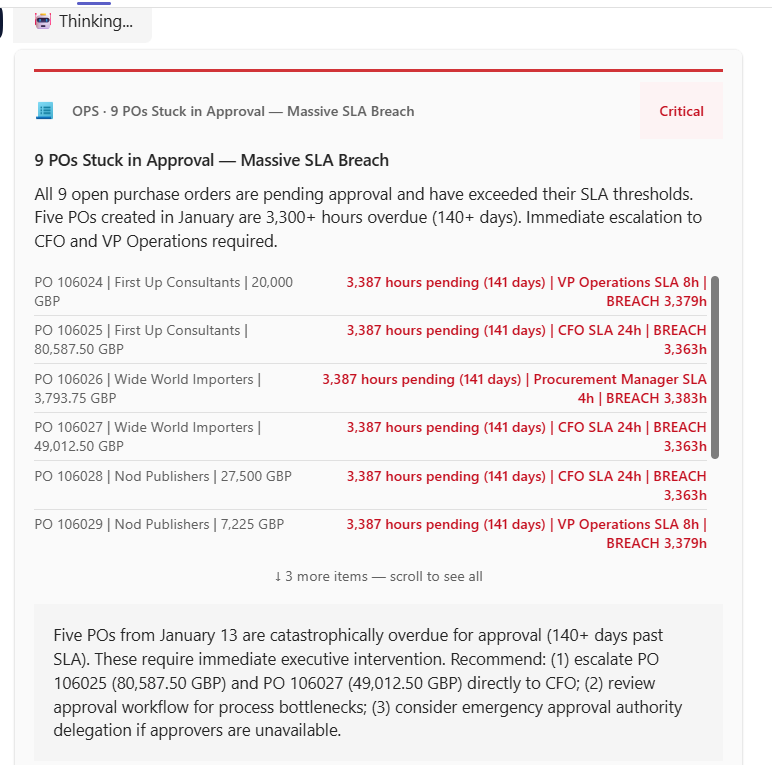
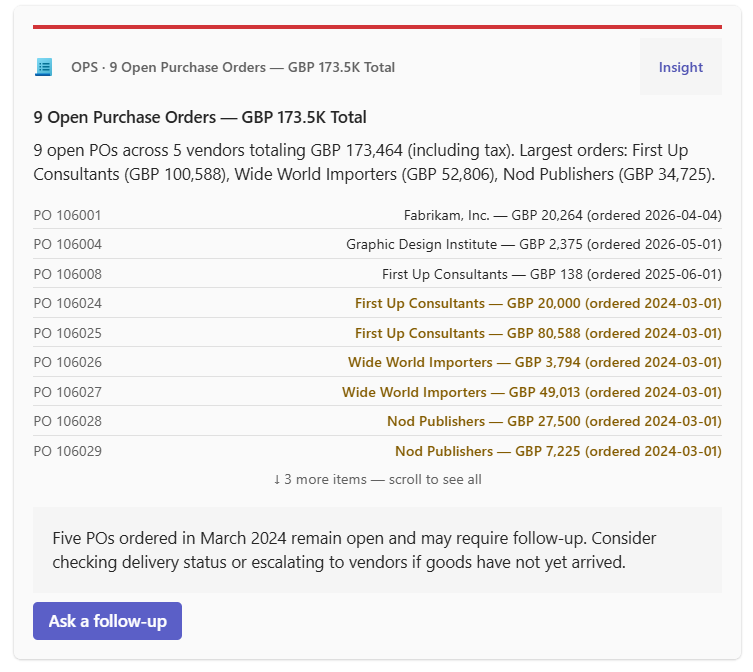
OpsGrid Beta · Dynamics 365 Business Central · sample data
Signal. Named owner. Approval. Execution. Audit trail.
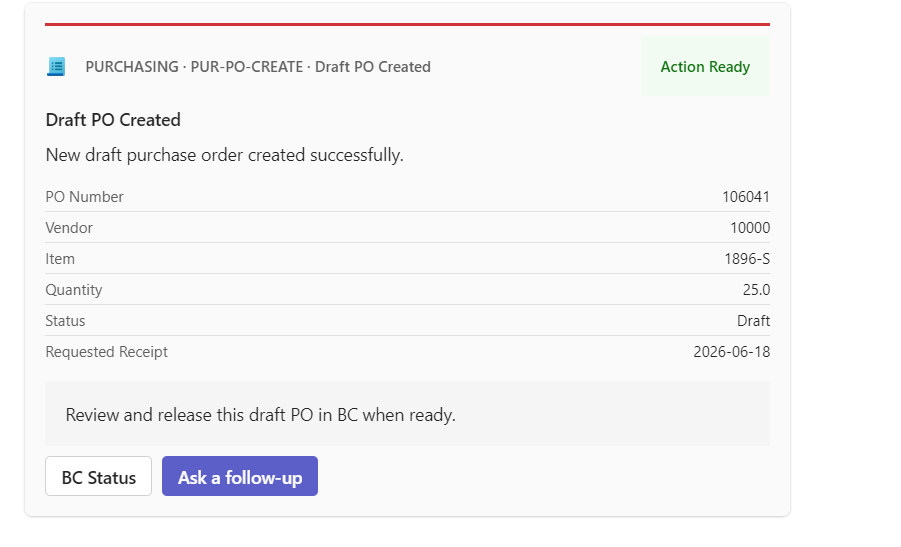
OpsGrid Beta · Dynamics 365 Business Central · sample data
The decision funnel, signal health, and full audit trail.
Every decision that ran through OpsGrid: who owned it, when it was acted on, what happened. A defensible record of how the operation was run. No export, no pivot table.
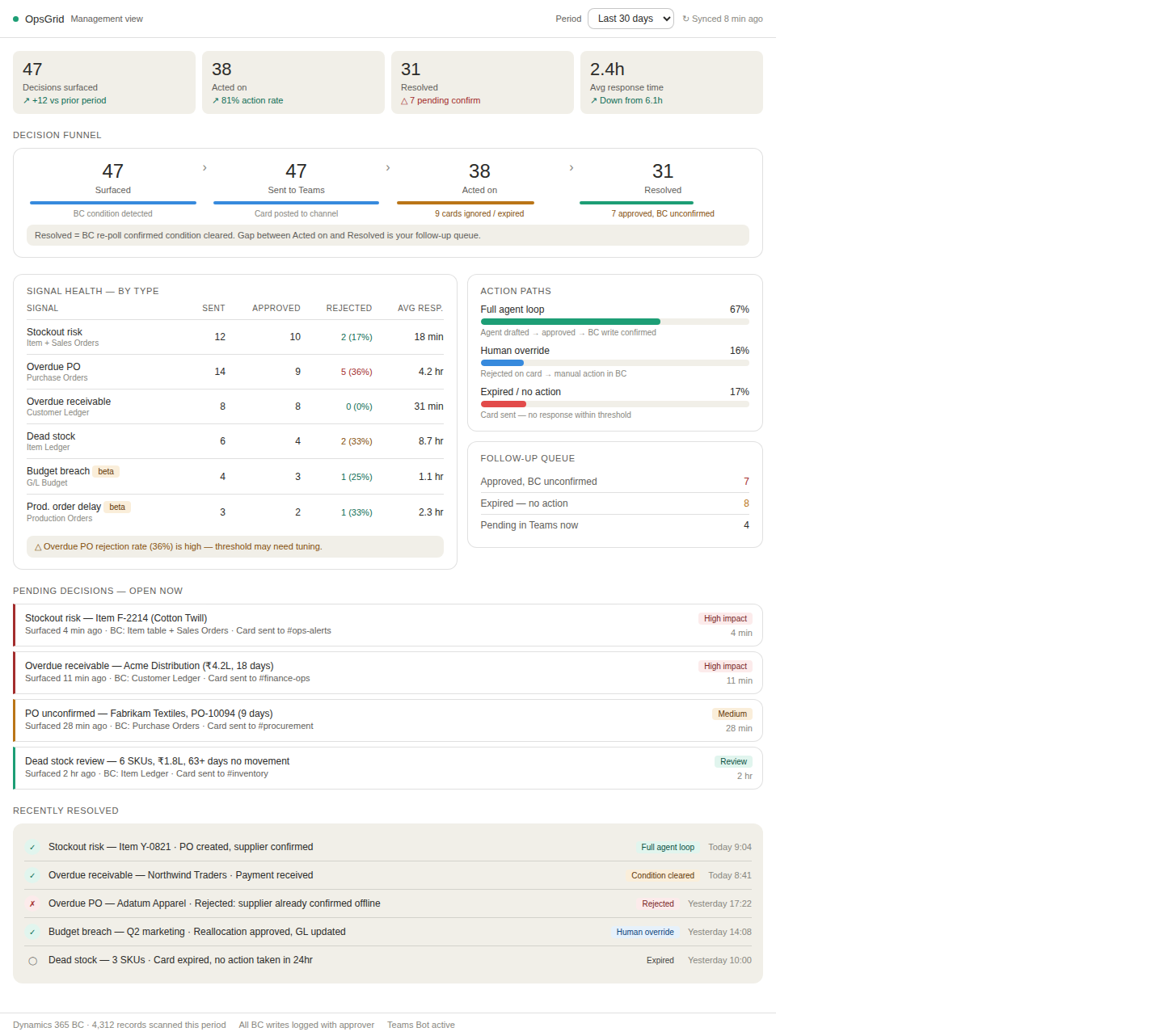
Actual OpsGrid Beta screenshot · Dynamics 365 Business Central · sample data
From one active OpsGrid beta deployment · Dynamics 365 Business Central · mid-market manufacturer · baseline at project start, outcomes at 30 and 90 days.
See where your BC decisions stall, in 3 minutes.
Not the cost calculator on the OpsGrid page: this is the stage-by-stage breakdown of where in Signal → Route → Approve → Execute → Audit your decisions stall. 12 questions, scored, mapped to your weakest stage.
Take the Decision Latency Diagnostic →12 questions · 3 minutes · Free · Full stage breakdown unlocks with your email