OpsGrid · Operational continuity · Business Central

Key-man risk isn't a people problem. It's a decision architecture problem.

Your operations run on institutional knowledge — who to call, which supplier was blocked and why, what that Thursday escalation means. When the person who holds that knowledge is unavailable, the knowledge gap is immediate. Cross-training transfers skills. It doesn't transfer the record of every decision that shaped how your operation runs today.

Decision Infrastructure

The record assembles itself. You own it permanently.

OpsGrid routes operational signals to named owners in Teams, captures their approval or override, executes the action in Business Central, and logs the complete chain — automatically. No documentation effort required. The institutional memory builds in the course of normal operations.

Signal
BC data crosses a threshold. OpsGrid detects it and ranks it by cost impact.
Route
Signal goes to a named decision owner. One person. One responsibility. SLA clock starts.
Approve
Owner acts in Teams — approve, reject, or override. Decision captured with full context.
Execute
Approved action writes to BC. Nothing executes without explicit human approval.
Audit
Who decided. When. What they chose. Every BC write logged. Institutional memory, assembled automatically.
No documentation effort Named owner on every decision Full audit trail, automatic Record survives personnel changes
What key-man dependency actually costs

When an ops lead leaves a mid-market manufacturer, the average time to restore full operational context in a replacement is three to six months — during which decisions slow, overrides get made without context, and margins erode. The root cause isn't the headcount gap. It's that the decision history was never recorded anywhere the replacement can access.

What OpsGrid records

Not a log file. A traceable decision chain.

Every entry in the OpsGrid decision record traces the complete path from signal to outcome. Each one answers the questions a new ops hire, auditor, or COO will ask.

What each record contains
Signal → Named owner → Decision → BC write → Outcome
Signal
What BC data crossed what threshold, at what time, ranked by cost impact
Routing
Which decision owner received it, under which routing rule, at what SLA
Decision
Approved, rejected, or overridden — with the override reason if one was given
BC write
Exactly what was written to Business Central, by which approval, at what timestamp
Outcome
Whether the decision resolved the signal, escalated, or expired without action
Question Knowledge in one person Knowledge in OpsGrid
Why is Supplier A on hold? Ask the ops lead — if they're available Decision record shows the override, the owner, and the date
Who approved last month's cost variance? Check email threads, maybe WhatsApp Named approver, timestamp, BC write — one lookup
New hire context timeline 3–6 months of shadowing Full decision history available from day one
Regulatory audit prep Reconstruction exercise — days of work Traceable to named owner, already assembled
Ops lead goes on leave Operations slow; informal decisions made without context Decision routing continues to named backup; record intact
How it works

Institutional memory that builds without any documentation effort.

OpsGrid monitors Business Central continuously. Every operational signal — stockout risk, overdue POs, production delays, cost variances — is detected and ranked by cost impact. No manual queries, no scheduled reports.
Signals go to a named decision owner in Teams. Not a group inbox. One person, one responsibility. The routing rule — who owns what type of decision at what value threshold — is itself a documented record of how your operation is governed.
Every approval, rejection, and override is logged automatically. The decision owner acts in Teams. OpsGrid writes the approved action to BC and records the complete chain. No extra steps. The institutional memory assembles itself.
The record is searchable and permanent. A new ops hire, a COO reviewing last quarter, an auditor asking who approved an override — the answer is in the decision record, traceable in seconds, not reconstructed over days.
Management view

The decision funnel, signal health, and full audit trail.

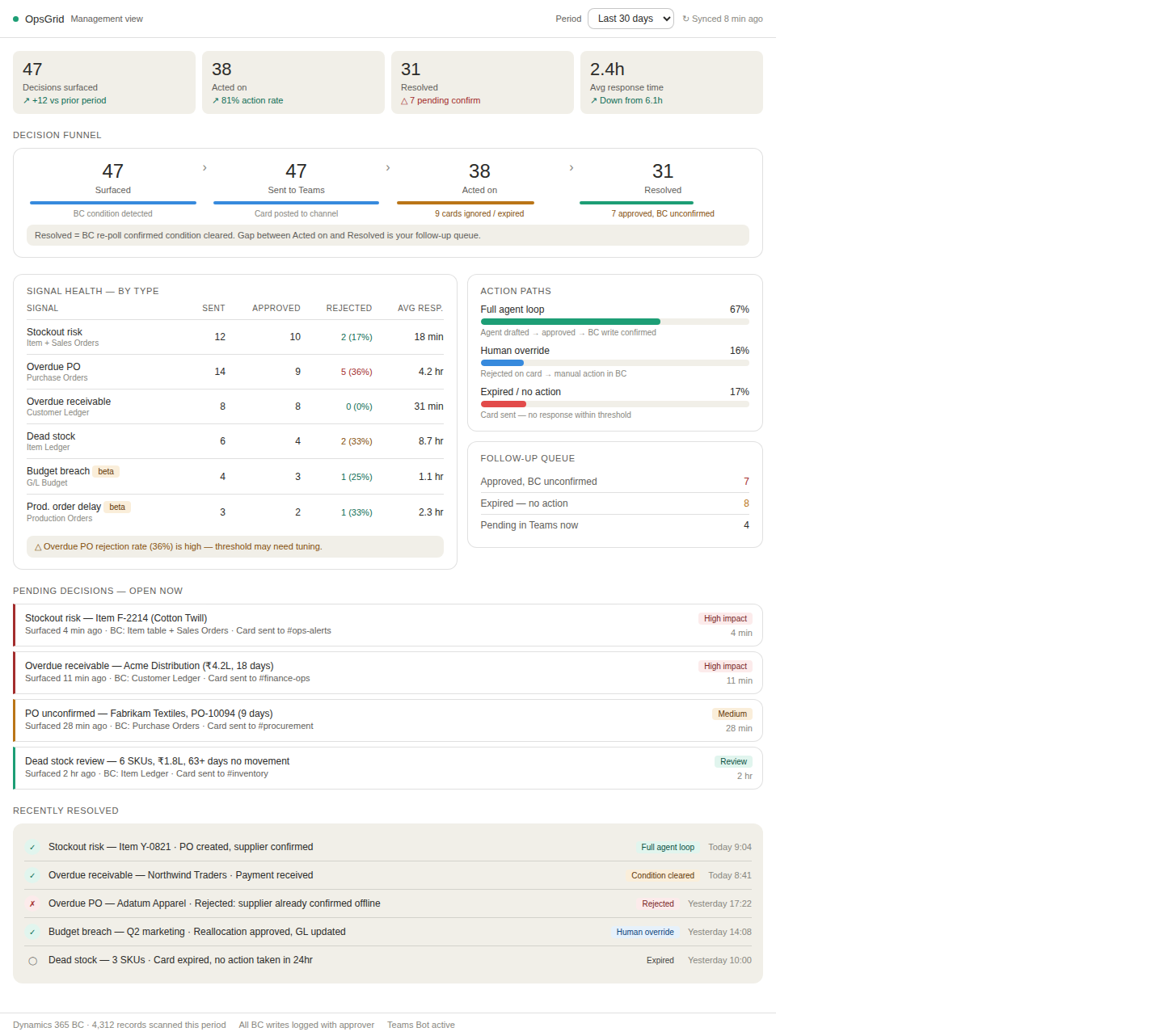
Every decision that ran through OpsGrid — who owned it, when it was acted on, what happened. A defensible record of how your operation was run. Available to your successor, your auditor, and your COO without any reconstruction work.

OpsGrid Management Dashboard showing decision funnel, signal health by type, and full audit trail of every approved and overridden decision
Decision funnel
Surfaced → Teams → Acted → Resolved. Every step logged. A new ops head can see how decisions moved through your operation before they arrived.
Named owner on every decision
Who owns which signal type is documented in the routing configuration. No ambiguity about accountability — in normal operations or during transitions.
Full audit trail
Every BC write logged with approver and timestamp. Override reasons captured. A traceable record your auditor, acquirer, or board can read — assembled automatically.

OpsGrid Beta · Dynamics 365 Business Central · sample data

What's next
30-minute call
Book a Decision Latency Audit

30 minutes. We map the 3–5 operational decisions your team currently handles without a formal record — and quantify what each gap costs when a key person is unavailable.

Book the call →
Read the analysis
Key-Man Risk Is a Decision Architecture Problem

The full analysis: why succession planning doesn't solve key-man risk, what a decision record actually contains, and how OpsGrid builds institutional memory without any documentation effort.

Read the article →
$0
BC writes without named human approval
3 wks
to go-live from BC connection
100%
of decisions logged — signal to outcome

From one active OpsGrid beta deployment · Dynamics 365 Business Central · mid-market manufacturer · baseline at project start, outcomes at 30 and 90 days.