From the deployment
Written from direct operational experience building and deploying a live FMCG trade operations platform, 2025–2026.
Month one. 12 buyers, 11 SKUs, three people running sales and factory. No catastrophic failure: no lost orders, no missed deliveries. Just three people holding the entire order pipeline in shared google sheets, and the moment that stopped working.
TradeFlow Crew is IntelliConnectQ's B2B trade operations platform, built when manual coordination hit its ceiling at Anveeka Trade. Anveeka Trade (an Indian food commodity exporter) is the first production customer. The platform is being scaled for FMCG distributors and agri exporters running the same coordination problem today.
The bet
Anveeka Trade launched with a deliberate decision: no IT system on day one. Validate demand first. Build buyer relationships. Run manual until volume justifies the build. A 3-month rollout plan gave enough runway to do this properly.
At 11 SKUs and local-to-within-state orders, that was the right call. Trading businesses have coordinated over phone calls, in-person visits, and chat threads for decades. Nothing about month one suggested that would break.
What broke
Orders outpaced the coordination layer before month one closed.
The sales team fielded inquiries across every channel standard in Indian trade: phone, in-person, chat. Approvals happened over phone. Factory coordination happened in person. Google Sheets had a single view of what had been ordered, what had been approved, and what the factory should pack that day.
The failure wasn't dramatic. No orders fell through. But with 12 buyers placing orders across multiple pack sizes and 11 SKUs, Google sheets was unable to hold the full picture. The team hit the ceiling a human coordination layer always has, before the 3-month plan said they should.
The problem wasn't missing discipline or the wrong people. The problem was structural: phone calls and chat threads summarized to spreadsheets are not a pipeline. They are a queue that only one person can see at a time.
The decision
Anveeka Trade had an unusual advantage: IQ's technical team was already embedded in the operation from day one. No requirements document. No vendor selection. No handoff.
The team that understood the operational problem could write the code to fix it.
Initial infrastructure: 5 days, built right on the first attempt.
What we built
TradeFlow Crew is a B2B trade operations platform built around three portals and a shared 5-stage pipeline. Every order moves through the same sequence, visible to buyer and operations team in real time:
- Placed: buyer submits via portal
- Approved: sales team reviews and confirms
- With Factory: order passed to production
- Ready: packing complete, awaiting pickup
- Picked Up: order fulfilled
Both portals read from the same order state. No sync. No duplicate entry.
Buyer portal. Order grid across all 11 SKUs and pack sizes. Normal, Outdoor, and Low-light display modes for buyers working in warehouses, outdoor markets, and direct sunlight. Chat share on order confirmation. Reorder any previous order in one tap.
Sales queue. All orders filterable by status, date, and buyer. Approve, hold, or flag in one action. Verified buyers with no manual-review flag move straight to factory. The team sees only what needs attention.
Factory queue. Aggregated packing plan across all approved orders. Total quantities by product and pack size in one view. The factory team starts each shift with a clear plan, not a stack of individual messages.
Rate master. Global pricing matrix editable inline per tier. Per-buyer overrides stack on top of tier pricing. Prices are snapshotted at order time; a rate change never reaches a placed order.
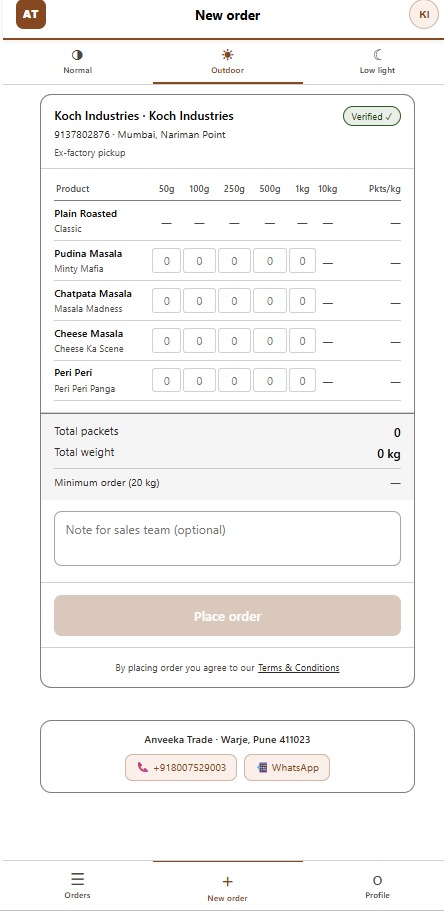
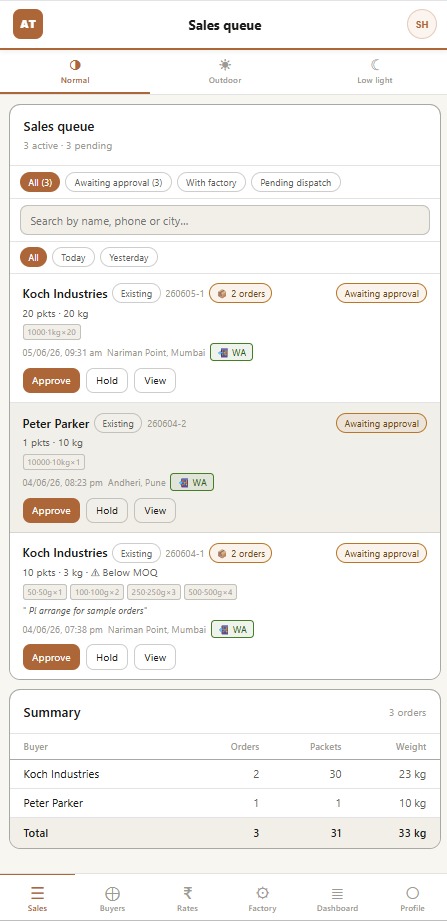
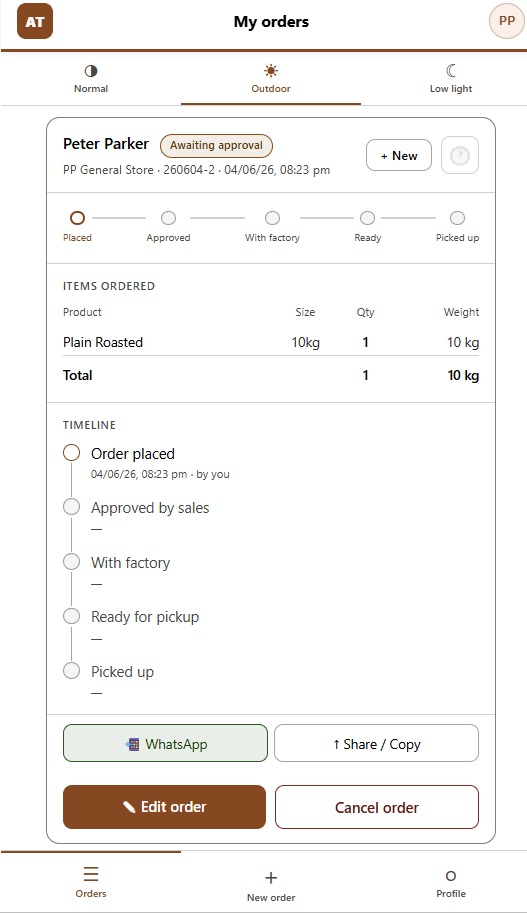
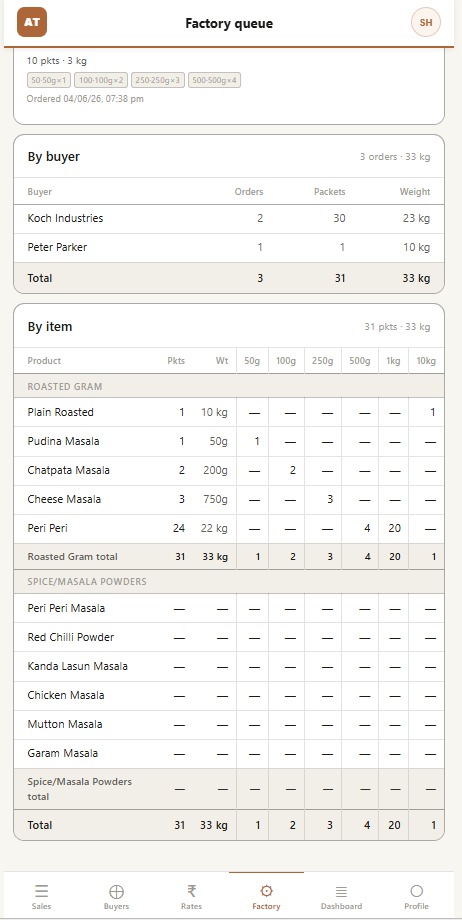
Most order management systems are built for the buyer experience. TradeFlow Crew is built for the operations team. The buyer portal is the front end. The production system is the product.
What changed
The coordination overhead that broke the team in month one now runs in the background. The three-person team manages the same buyer volume without carrying the pipeline in their heads.
One thing the system can't fix: adoption discipline. Buyers default to chat tools like WhatsApp. Sales teams have habits. Factory staff trust verbal briefings. The first 30 days after any deployment are an adoption problem, not a feature problem. The platform works when the team stops treating it as optional.
Where this goes
Anveeka Trade already runs Phases 3 and 4 manually today: export documentation, overseas buyer management, LC and phytosanitary workflows. The roadmap isn't speculative. It's systematising what the business is already doing by hand.
- Phase 1: Domestic OrdersBuyer portal, sales queue, factory queue, rate master, buyer tiers, staff roles. Live.
- Phase 2: Supplier & Production ChainRaw material sourcing, transport tracking, multiple production houses, farmer supplier chain. Credit & payment control: buyer credit limits, outstanding tracking, payment aging. Exception workflows: partial fulfillment, urgent overrides, price disputes, returns. Contribution margin per order. Domestic dispatch tracking.
- Phase 3: Export DocumentationCustoms clearing agents, Certificate of Origin, phytosanitary certificates, CoA & APEDA/DGFT documents, ICEGATE integration.
- Phase 4: Overseas Buyer ManagementOverseas buyer portal, purchase orders & PFI, dispatch & bill of lading, LC documentation, multi-currency, multiple overseas sales teams.
Phase 2's credit and exception modules address what any experienced Indian trade operator flags immediately: unchecked credit exposure and no exception workflows are faster business killers than coordination complexity. They're in Phase 2, not Phase 4.
From internal tool to platform
TradeFlow Crew started as a production system we built for Anveeka Trade: a real business with real buyers, not a prototype. It's built for FMCG distributors and agri exporters running the same operational pattern. This case study is the proof of concept. If your operation matches what's described (manual coordination across phone and chat, a factory team working from verbal plans, pricing disputes from mid-cycle rate changes), the next step is a scoping call, not a sales deck.
Frequently asked questions
Who is TradeFlow Crew built for?
FMCG distributors and agri exporters with 10 to 200 staff managing buyer orders across phone, chat, and in-person channels. If your sales team coordinates over WhatsApp and your factory team starts each shift from a verbal briefing, TradeFlow Crew replaces that coordination layer with a structured 5-stage pipeline and role-gated portals.
How long does implementation take?
Initial infrastructure took 5 days for Anveeka Trade, built right on the first attempt. That speed was possible because IQ's technical team had direct access to the operational requirements: no requirements handoff, no vendor lag. For a new deployment, onboarding depends on product catalogue complexity and buyer volume. Stabilisation takes the following month. We scope this before quoting.
Is this only for export businesses?
Phase 1 covers domestic and within-state FMCG distribution. Export documentation is Phase 3. You don't need to be an exporter to use the platform today.
What makes this different from a generic order management system?
Generic OMS platforms are built for the buyer experience: online storefronts, customer notifications, self-serve returns. TradeFlow Crew is built for the operations team running a trading business: sales approval queue, factory packing plan, tiered pricing with per-buyer overrides, and price snapshots locked at order time. The buyer portal is the front end. The production system is the product.